The Ethics and Psychology of Using LLMs
DISCLAIMER: This is a blog and these are my personal thoughts. Don't let the title fool you. Don't use me as a source of factual information or expect professional levels of expertise and discussion in what is primarily a written experience personal to me. There's a reason I don't include proper citations or structure these like research papers. Do your own research!
It's already been a month since I first deployed this website. Somehow it feels like it's been a lot longer. I've had a fair few rants and ideas and so on that I've come close to posting up on here since, but I ultimately decided against each and every one because they felt too short to be of any substance. One was a random post about Valve's web design for Deadlock's latest update since I bitched about web dev on this site's front page, and the other was a rant about an anime that I watched years ago because I suddenly remembered how infuriating its ending was (Wonder Egg Priority, for anyone who shares my pain).
I think I was trying to force myself to write a blog post just to populate this website rather than letting my words come naturally. Those are the kind of things I should save for Bluesky, not that I really use it that much.
So this post isn't that. Everything I write here is written because it's important to me. It's partly a reflection of what I've been up to for the last month and partly a call for discussion that I desperately think needs to happen in an open space. You'll see what I'm getting at.
Let's start with what I've been up to.

Claude Code vs. The Desire for Tech Independence
I've mentioned before that I self-host this website, among a few other things. My position on software as a service and the trend towards renting compute should be clear from that alone, as if using Linux and staying as far away from Microsoft as possible wasn't enough of a giveaway.
The idea of every action I take when using a service being logged and stored and sold and processed by third-party vendors sickens me and makes me feel more like a cog in a very large machine than a person trying to use tech to do and make cool things. So I prefer to do stuff where my data never has to leave my machine as much as possible.
But of course, a month ago, I put up my first blog post on this website talking all about Claude Code and how incredibly competent it is. I used it to make this website because I've written web servers before and didn't want to do a front-end. I've since also used it to make a niche terminal user interface I had been putting off. I can't deny how useful it is.
Yet I do not control Claude. Every prompt I send goes directly to Anthropic and all I have is their word on how that data will be used. They could build a profile on me if they so wanted, and I wouldn't trust them (nor anyone else) not to even if they promised not to. Using Claude Code therefore runs directly contrary to my preference on data privacy, but I was willing to make the concession because of just how useful frontier models have proven to be. I didn't want to be 'behind' everyone else by avoiding cloud models any longer than I had been.
That didn't stop me from looking into local alternatives.
Enter Qwen3.8-27B (which I will henceforth refer to as Qwen): an open-weight model I did not have enough VRAM to run locally a month ago, but a model that has had its praises sung far and wide when it comes to—well, just about everything. I wanted to give it a shot. And I wanted to be able to use local LLMs for simpler troubleshooting and document management. So I decided to burn some money. The inability to host my own models was part of my reason for turning to Anthropic in the first place, and chances are that the consumer GPU market is going to become extinct if I keep waiting anyway. So why not upgrade now?
Good Luck Buying a 5090, Buddy
The first problem I encountered on this path was that all of the high-end GPUs are ridiculously priced right now. Any card with more than 16GB of VRAM feels like it's disappearing into the aether within seconds of being listed online, and that's ignoring the insanely high prices when they do become available. I wanted a budget option, and my main constraint was VRAM, so I bought myself an RTX 5060 Ti 16GB. If VRAM was the ceiling I was trying to raise, then this was the best card I could find at the time in terms of GB VRAM per £ while sticking to NVIDIA.
Yes, yes, I should've gone with AMD. I wanted to use it in conjunction with my existing RTX 2060, okay?
At least, that was the plan until I bought myself a second 5060...
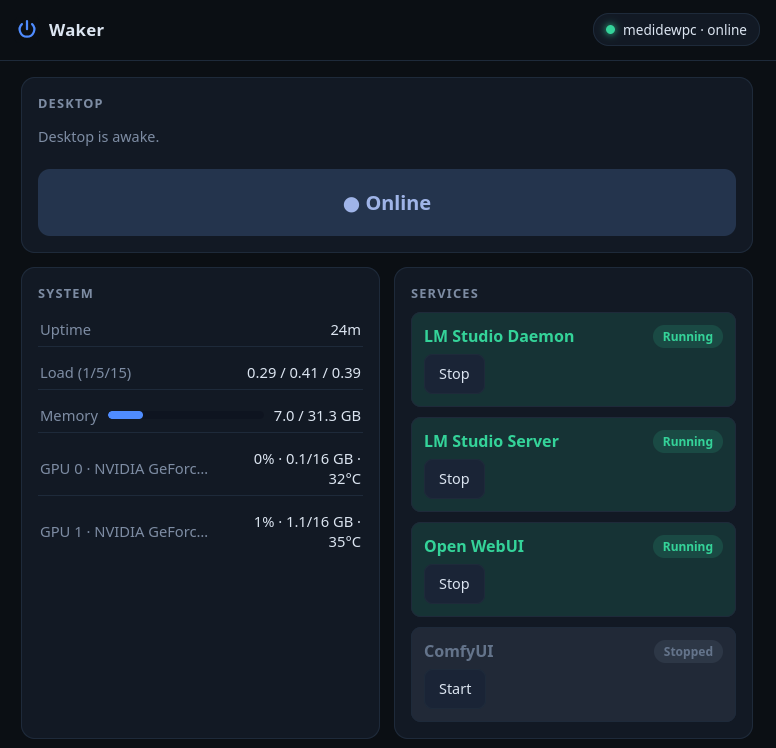
Look, the important thing is that now I have the VRAM to tinker with this stuff. I've since spent a fair amount of effort configuring my PC to be able to run like a headless AI server with Wake-on-LAN so I can access that VRAM whenever I see fit, but I'm very happy with the purchase. I gave it a spin writing my waker dashboard for controlling that very Wake-on-LAN setup I just mentioned, and it did a really great job. Not as good as Claude, but I expect that's because Claude fills in the gaps between my prompts a lot better than Qwen does. I'll probably continue to stress test Qwen in the coming weeks and see if that's true.
But if that's all I came here to say—that I wanted local AI so I bought the hardware for local AI—why is there still so much text left to go?
The Ethics and Psychology of Using LLMs
This is the crux of what I really want to talk about, and where the majority of my concerns and reservations with using LLMs lie. I know that everyone rolls their eyes when they see or hear the word 'ethics', but hear me out.
I mentioned in my last post that there is a very vocal group of people against AI and LLMs (although I may have exaggerated the majority's misgivings for comedic effect). While some members of this group genuinely believe that AI cannot generate anything of good quality, I believe that most of them are more worried about the technology overreaching and 'slop-ifying' things they care about and infringing on their expertise. In that same post, I also mentioned that there is a group of people who feel the opposite: those that have chosen to adopt the technology (or been forced to by their jobs) and genuinely perceive more merits than losses.
Assuming you have access to the internet, the existence of these two groups is news to nobody. We've all seen those YouTube videos and social media posts shilling AI as the future, as well as the detractors in the comments hoping the industry crashes and burns. People fight over generative AI all the time. Heck, just look at the Linux Kernel community right now. Those are extreme examples, of course, but I bring these two groups up because I have friends and family on both sides of the fence. And while I don't fit neatly into either group anymore, I can see where both sides are coming from.
For example...
Artists, creators, and anyone who takes pride in the quality of their work do not appreciate having their art form or skillset infringed upon and their community diluted by low-quality AI generations that miss the subtlety of their craft, especially given that a lot of creative works have been trained on without permission. Myself? I like to write novels sometimes and—while most of that work will probably never see the light of day—I feel nothing but contempt for people who substitute the entire creative process for the output of an LLM. What's the point in sharing a novel if it isn't written by a person, injected with their thoughts and views and commentary? Are you just trying to make money or are you writing about something you actually care about? What are you learning or injecting if it's the latter?
It doesn't sit right with me.
On the other hand, engineers, clerical workers, or people who are more concerned with finding a solution than having the solution be perfect have a very legitimate use case for LLMs, and barring any restrictions around data protection laws they would be daft not to use them to increase their productivity. If an LLM can ship software features faster than I can for a commercial product, shouldn't I use it? What about writing or reading documentation that would otherwise prove to be time-consuming?
LLMs are also great for substituting skills you don't have. If you don't have any idea how to make a website but you know what you want that website to look like and you can give clear instructions, you'll probably be very pleased with the result if you give those instructions to Claude. You might ostracise every web designer in the process, but you can't deny it's cheaper. I can't imagine being a web designer and watching potential clients churn out AI-generated websites when you know you could make something better. I would be pissed...
Now, I doubt I have encompassed the thoughts and feelings of everyone who does or doesn't want to use LLMs, but the point is that none of the groups and use cases I've listed have any inherent ill intentions. You can see where they're all coming from, and they clearly have different priorities, but no one here is ignorantly declaring that AI users are scum of the earth, and not everyone promoting AI is trying to put you out of a job. Some people are righteously frustrated and others are just trying to get stuff done.
So should you use it?
Well... yes, and no. Although if you can't decide for yourself then you're already halfway there to be honest.
I think that any one person's answer comes down to a balance of practicality against their moral compass and where they're willing to compromise. Because I definitely feel like I'm compromising. If it was as simple as putting yourself at a disadvantage by not using it then it would be pointless to ask such a question, but you cannot separate LLMs from the data used to train them and there are legitimate concerns here.
Training Data from the Seven Seas
A lot of commercial AI models are (allegedly) trained on data that contains copyrighted intellectual property. Books, scripts, artwork, etc. that the large tech companies making these models didn't have the permission or licenses to use in training. So for my artistically inclined friends out there, when someone uses an LLM to produce or edit a literary work, for example, it feels like they're profiting off the hard work of the people that came before them without anyone subsidising the cost. Same with art and images. Same with video. These models learned, in part, how to do what they do without the consent of the people who own the content they were trained on.
In my opinion, that should leave a poor taste in anyone's mouth. Most of those people were just doing honest work.
Maybe it depends how you see it. If you view LLMs as a form of regurgitation and plagiarism then it's the equivalent of me copying someone's essay or book and passing it off as my own when someone asks me to write for them. If you view the LLM as 'learning' the skills on display in its training data, in the same sense I might learn from deconstructing someone else's work, then it becomes a question of scale and agency. Training datasets contain millions of novels and essays and videos and songs that were scraped and used with the express purpose of developing something that can be sold commercially. If I marketed my business around an unrelated individual's work, I'd be forced to pay damages for it. Large tech companies should be held to the same standard.
Now, this is a serious concern that governments and courts are looking at. It's part of a greater legal process that's progressing a little too slowly for my liking, but the fact of the matter is that it's being figured out as I write this. And if this was the only concern that I had then it would be a done deal as soon as legislation finished drawing the line.
It is not my only concern.
Critical Thinking and Skill Degradation
I already knew about this going in. Hell, I referenced it in my original post. It was one of my biggest reasons for avoiding LLMs in the first place back when everyone was substituting their search engines for ChatGPT. Rely on the chatbot too much and you'll stop exercising your brain and stop learning new things. Outsource too much and you'll stop practicing the skills you outsource. I thought I knew that, but then I recently watched this excellent video by Brett Codes that perfectly encapsulates many of my existing concerns.
It also gave me a bit of a reality check, because this past week I've been having fun. A lot of fun. Setting up and tinkering with new systems and new tech is something I really enjoy, and getting my hands on and installing two new GPUs to run inference on my own PC? Of course I'm going to go giddy testing out what these open-weight models can do. I've been using them for debugging, for research on further potential desktop upgrades, for scanning GitHub repos and recommending replacement headphones, and so on. Even as I write this I'm running Qwen in the background to make adjustments to this website and save me some time.
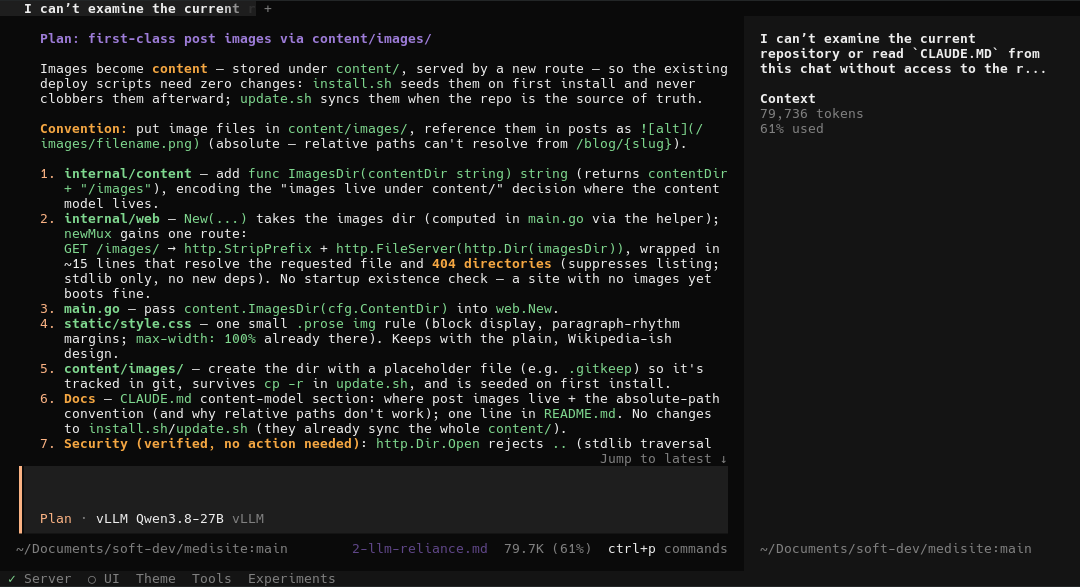
Yet I'm doing exactly what I told myself I wasn't going to do over a year ago.
This, I think, is quite possibly the single biggest reason anyone can have for swearing off the technology entirely like Brett Codes, and I do not blame them. If I wasn't having so much fun setting up systems around it and hadn't made the investment I'd just made, I might even consider doing the same.
So how do I keep my own use of LLMs in check? Should I make sure I work on projects free of their influence going forwards so that I keep on learning new things? Probably, yes, but how do I make sure I stick to that when using this technology on the regular?
It's complicated. There are people who will cite this skill degradation as the ultimate evil of generative AI and chatbots, and there are people who will say that these risks are exaggerated. I know there's research out there to suggest that the risk is very real, but I'd be lying if I said I had a paper to cite off the top of my head and I'm not going to link one. How would you even know I've read it? Do your own research dammit!
The bottom line is that it's impossible for me to know how significant the risk to my cognitive abilities is without letting LLMs pass or fail the test of time. But waiting risks falling behind everyone who's learning how to use AI effectively. I have to be prepared for both eventualities.
LLMs are useful. They take care of work I don't necessarily want to do myself, and no matter what vows I make to 'keep myself in check' I will probably keep using them for such work unless I see it as detrimental to do so. I won't let an LLM write my emails for me, even if I don't like writing those emails, because my personal communications should come from me. But I'm not against using them to manage and sort those emails, provided those emails never leave my machine. I'm not against getting them to write project documentation I would otherwise ignore or to act as a form of primitive quality control before I declare anything a finished product. I am one person and I only have so much time upon this Earth.
That opens up two problems: how do I stop myself from becoming overly reliant and what do I do when local models aren't enough?
Because while none of this is particularly new to me, the last month has shown how easy it is to slip into unhealthy LLM-using habits. I think it perfectly demonstrates just how convenient and easy-to-adopt this technology is—it's literally like texting after all—and I'm incredibly afraid that if I don't govern my own workflow then I'll lobotomise myself, even with measured caution. I will not be reduced to a machine's meat proxy.
Moving Forwards
Regarding the limitations of local AI (since that's the easier question to answer), I'm actually not too concerned. If I have a task too complex for myself or my local agents to handle, the first question I should ask is whether I should be using an agent at all.
If my stance is that I'm afraid of skill degradation and I want to use LLMs to take care of menial work, then do I even need to use an LLM for complex tasks? Unless I already know how to write exactly what I want the LLM to code (or it's a non-coding skill I don't care to learn, whatever that may be) then I shouldn't run into this issue. If I somehow do—and therefore need to use something like Claude again—it mostly comes down to a question of data privacy and what information leaves my device.
But privacy isn't about refusing to give anyone your data so much as it is about having the choice of where it goes. So long as I know exactly what data gets sent to whatever provider I'm using (probably just snippets from an already public repository) then there isn't an issue. I'm not being tracked against my will, which is where I have a problem, so if I have to spend a few quid every now and again to use a frontier API, so be it.
Cancelling my Claude subscription to save money and only using OpenRouter when I need it is a pretty neat incentive too.
However, stopping myself from becoming reliant is harder. Any system that is capable of doing work I cannot do is a temptation. People are lazy. I... have been known to be lazy from time to time. LLMs make me feel productive by pumping stuff out, even if I'm not actually doing anything but providing oversight in a minimally interactive process. That is a dangerous trap to fall into. I might prioritise my own professional development now, but what if there comes a day when I have so much 'stuff' I want to make that I'm just offloading all of it without a second thought?
Most of my DIY incentives either come from the perspective of saving money or love of the craft. The electricity cost of running these GPUs is mostly negligible, so emotion is what I need to lean into here. But relying on feeling is inherently unreliable. I've fallen out of love with tech once before and I'm not naive enough to believe it can't happen again. Taking a break is usually what helps me reset, but if I'm using LLMs on the regular for my work is 'taking a break' still an option? How do I stop myself from succumbing to their all-encompassing capabilities during these moments of weakness?
To be perfectly honest, I don't think there is a golden solution. Everything I can think of relies on my own diligence, but I suppose you could say the same for any facet of human health. I think the best I can do is try to build healthy habits—going out of my way to do software and research projects that don't involve AI whatsoever, dedicating days to unplugging my PC and only using my laptop or phone without waker online. I already draw a hard line at using LLMs to write any of my novels for me, so maybe I should have faith in the boundaries I set for myself. There's always the chance that I might fail to uphold those boundaries, sure, but there's always a chance I might develop a Pepsi addiction if I'm not careful.
Simply put, I should have faith in myself. As boring as that answer is.
It might come as a surprise that I'm not setting more concrete goals, but I tend to work best when I keep myself loose. Start ticking boxes and everything becomes a chore. I trust myself to do those non-LLM projects every now and then, and all it'll take is one look at my GitHub to hold myself accountable.
I guess we'll just have to see how it goes. I look forward to seeing which way the wind blows.
Closing Tangent
Not to plug myself or anything, but I did say this should be a discussion. If you have any thoughts about this post, let me know on Bluesky! Or tell your mum or something. Either works.
I don't know about any of you, but sometimes I get halfway through writing something I'm going to share online and start doubting whether I've actually said anything of substance. Like, I'm passionate about this stuff and I've thought about it a lot, but I also feel like most technically inclined people who use AI or have considered using AI probably know about all of this already. They probably also know about other ethical aspects I haven't covered here (because they aren't what I wanted to talk about), like the insane damage data centres are doing to the environment, but I guess that's why I framed this website as more of a casual, rambly thing rather than a super professional personal selling point. That, and I'm talking about my own experiences anyway.
Bah, it's fine. If you read this far you probably found some value. If you didn't, it's no skin off my back. I'm happy to put metaphorical pen to metaphorical paper either way. I just really want the ethical conversation behind LLMs and AI to be more pronounced when expecting people to adopt or shun this technology. I worry that as LLMs continue to improve and are adopted by more and more businesses, people will feel forced into using these models so that they aren't at a disadvantage. When there are this many ethical concerns to think about, that doesn't feel right to me. So I chose to write about it.
Anyway, I hope you enjoyed reading this post. It's by far the longest rant I've put out yet (which isn't a hard goal, considering it's only my second blog post), but this discussion was at the forefront of my mind today and it felt like a fitting way to cap off my week-long dive into local LLM inference, so thanks for stopping by! Hopefully the next one won't take me a month. :P